
Our guest
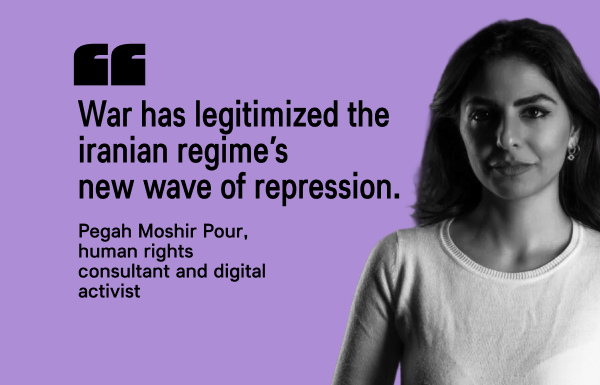
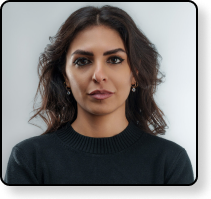
Pegah Moshir Pour
Human rights consultant and digital activist. Italian-Iranian, she has brought the demands of the Iranian people — and of the Woman, Life, Freedom movement — to European institutions and public audiences.
Editor’s note: The interview was conducted a few weeks ago. Since then, some of the figures cited by Pegah Moshir Pour have increased. The number of days without internet in Iran has surpassed 66, and the death toll has risen to 21.
THE SILENCE BEHIND THE STRAIT
Given the daily reports about the management of the Strait of Hormuz, is it possible that the Iranian regime’s leverage in negotiations has actually increased since the start of US and Israeli military operations at the end of February? More broadly, do you believe the desire for revenge and the war have essentially revitalised and re-legitimised the dictatorship in the eyes of the Iranian people?
This is very complex to describe, because there are so many currents within Iranian society. What we can say is that the majority of the population — that segment which took to the streets, especially in the big cities — has shown a level of discontent that has truly cut across all demographics.
This is no longer just a youth issue, or a question of restrictions on clothing. We are dealing with a regime that is profoundly corrupt and has largely abandoned its population to face severe economic and financial hardship. Among those opposed to the regime are pensioners, who have been receiving only half their monthly pension since 2018. Even before COVID, there were already large groups of pensioners, teachers and professionals constantly speaking out about their conditions. Discontent has been widespread, and has been for a long time.
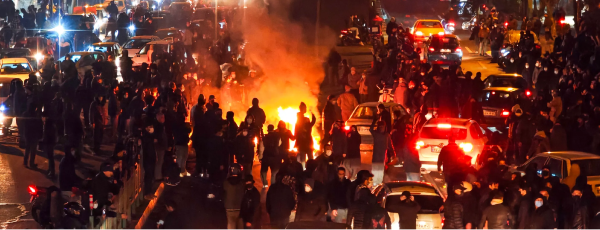
The only thing that seems to matter now is control of the Strait of Hormuz, and above all its consequences for the global economy. Once again, Iranians feel alone and betrayed — because the demands of the people are being pushed aside in favour of broader geopolitical and economic interests. Before this war, the regime held economic, political and financial power; now it has practically total control of the country. The war has legitimised a level of internal repression we had not seen before. We have watched 15 people hanged in the space of ten days. The bodies of those young people have still not been returned to their families.
Consider what happened after 8 and 9 January: a massacre that affected 56,000 families across Iran — people killed, blinded, arrested. But from the outside, it is as if this war has buried everything that came before. There is now a deep fear that all the hard work done in recent years — especially by the Women, Life, Freedom movement, which the world witnessed in 2022 — will be set aside and forgotten, because economic negotiations are deemed more important. And unfortunately, that fear appears to be well-founded.
We genuinely do not know what is happening inside Iran right now. That is the most absurd part of all: we are on day 50 of a complete communications blackout, and the world is not talking about it. If we are discussing negotiations, then the very first demand should be restoring internet access and opening up communications — because 92 million people are in total darkness.
The European Union has the capacity to amplify the voice of the Iranian people. I remember the volume of reports, requests and testimonies that reached the European Parliament. That institution still exists. It is time for the European Parliament to take responsibility and stand as a guarantor of the population’s human rights. Because on one side, the regime is fighting for its own survival. On the other, Donald Trump is focused solely on securing profits and advancing his own interests. Someone has to speak for the people.
THE EU AS A GUARANTOR OF HUMANITY
With that in mind, what role do you think the European Union could realistically play here?
The European Union can stand on the side of the population. And that does not mean taking a position for or against the war — that is an entirely separate matter. Human rights cannot be placed on the same level as geopolitical positioning. In my view, the EU is the only entity capable of taking responsibility for the rights of the Iranian people, beyond political calculations and beyond the individual stances of member states. China cannot do it. Pakistan cannot do it. The European Union must.
If the EU enters a game between superpowers, it will inevitably come out on the losing side — it simply does not have the negotiating weight for that. The one real, concrete contribution the EU can make is on human rights, as enshrined in the Charter of Fundamental Rights, which forms part of the EU Treaties.
As for the condemnation of the war — that is a given, an absolute no-brainer. But what we really need to address here is the narrative. The current short circuit around the Iranian question is this: anyone who speaks out against the regime is labelled imperialist, while anyone who is anti-imperialist is therefore assumed to be with the regime. But these are not mutually exclusive positions.
THE 80% MAJORITY: A SILENT TRANSFORMATION
You described Tehran as if it were fundamentally a European capital. What is the real difference — politically and in terms of civic engagement — between the rural and peripheral areas of Iran and the major cities, including the capital?
Let’s start with the one statistic we have in Iran regarding popular support for the regime: just 20%. Looking at the most recent presidential elections, out of 92 million people, only 20% turned out to vote. Even that very conservative segment — often linked to the Pasdaran — had already withdrawn, having been betrayed once again. This is why there is no belief in the possibility of reform within the Iranian system: the reformists have failed, and they are no different from the others. Reformism cannot lead to change. That is why the only figure we have for people who no longer want the regime stands at 80% of the population.
In Iran, you cannot conduct polls, you cannot carry out investigations, you cannot do anything — everything is controlled. So the Iranian elite, which we might generously put at around 20 million people — where is everyone else? The rest are silent. They have been silenced, kept in the dark. And we need to talk about that part of the population, the part that cannot find a way to react from within, nor to be represented from the outside, because right now no one is even speaking about them.
That small elite holds enormous power. And yet, the Women, Life, Freedom movement — a deeply significant cultural movement — showed us that even the suburbs and more rural areas were saying no, becoming more emancipated, and demanding real change. This led to a wave of civil disobedience: women removing the veil, the organisation of women’s marathons, female motorcyclists rallying in the streets. All things that are theoretically forbidden in Iran — just as men are forbidden from wearing shorts or dressing outside cultural norms.
The regime found itself having to arrest millions of people for acts of disobedience. That is why, when protests erupted on 28 December 2025 in the Tehran Bazaar, students and all those who had started the protests in September 2022 immediately joined in, once again becoming openly anti-regime. And yet, as we have seen, the regime could not be overthrown.
That is why Iranians were asking for help this time — help that needed to come from the United Nations, from the European Union, from coalitions of democracies. Not easy solutions to complex problems, but at least institutional support. Instead, our silence and inaction effectively gave Donald Trump the green light to do as he wished on 28 February.
And perhaps the approach of European states was precisely to support, or not oppose, American intervention — without taking on any direct responsibility. In a way, making someone else accountable for a problem that is very real, but that goes beyond…
Yes, and I hope that from this experience we can draw a lesson — particularly regarding international law and the United Nations veto system, which is fundamentally broken. We cannot allow everything to be blocked because countries like China and Russia have vetoed every resolution against the Iranian regime. There was so much we could have done, even before now. We didn’t. We need to seriously interrogate ourselves, as a global community, about what tools we have to shape the course of history. Technology has changed everything — but with that comes greater danger for civilian populations. All of this falls within our collective responsibility.
RECOGNIZING THE DIASPORA AS A POLITICAL ACTOR
Is there any possibility that an opposition could emerge from within Iran’s institutional apparatus — something the population could turn to? What movements exist today that could potentially be institutionalised?
Iran has a highly politicised and very active civil society, so something is certainly taking shape underground. But it cannot surface openly — if the regime were to fall tomorrow, it would immediately try to silence the students, the artists, the filmmakers. You can’t just announce you’re forming a party today once it’s over. Iranians are waiting for the right moment, but right now that moment is genuinely unthinkable and extremely dangerous.
That is why, I believe, one of the things the European Union can and should do is formally recognise the Iranian diaspora — and begin bringing the Iranian people’s demands to the political and diplomatic table, through the diaspora. Not only the regime’s positions, and not only Donald Trump’s positions, but also the voice of the diaspora, with all its complexity and internal differences.
But putting that in writing, formally…
It must be formalised, precisely because of those contradictions and differences that exist within the country. Otherwise we cannot move forward, because right now it is Donald Trump alone who is deciding.
There is also the presumption among some Westerners that the Iranian population wants an American-style democracy — that installing an American-backed leader would mean liberation for the Iranian people. Which is simply not true.
Iranians do not want a return to the monarchy — I am absolutely certain of that. I believe the majority want a secular, democratic republic, because they have already suffered too much. And I’ll add something else: there are many deeply religious people, devout Shiites, who are in prison. One of the most prominent activists — and we do not know if she is still alive — is a woman who wears the veil. She lost her husband in Syria during the war with Iraq; she comes from one of those families who paid the ultimate price. She knows exactly what this regime is. And yet she was among the very few with the courage to say publicly that its leader is a criminal, responsible for the deaths of hundreds of thousands of people — and she says all this while wearing the veil, as a believer, a practising Muslim.
And despite this, she was imprisoned.
Of course. And that tells us everything: this is not about religion. It is about power — and above all, about the legitimacy of whoever claims the right to represent the regime.
Interview conducted by Andrea Fernando Palazzo.

What is Eumans doing these days?
→ May 9 — Europe Day.
Many pro-European organisations will mark the day with events. We believe more should be done than simply waving a flag: to be truly pro-EU, Ursula von der Leyen should protect the International Criminal Court from Donald Trump’s sanctions, as called for by the joint campaign of Eumans and No Peace Without Justice.
If you’d like to join a demonstration on May 9, just reply to this email: we’ll tell you if there’s an event near your city and send printable materials.
→ Civic AI webinar #3 — Is there an alternative to Big Tech?
There’s a whole ecosystem of platforms building technology for citizens rather than for profit. But how far can it grow in a market dominated by the tech giants? Fragmentation, access barriers and low awareness are huge constraints. Are interoperability and simplicity the way?
Join us on May 20, 6:30–8 PM CEST to explore who controls participation online, and how civic tech and open-source platforms can be a real alternative — if adopted at scale.
Interesting things happening in Europe — for us
→ Tunisian League for Human Rights suspended.
In Tunisia, President Saied has suspended the Tunisian League for Human Rights, a historic Nobel Peace Prize–winning organisation. The League had supported the Eumans / No Peace Without Justice campaign against Trump’s sanctions on the ICC. The suspension looks like part of a broader decline of Tunisian democracy, once hailed as a success of the Arab Spring.
→ National Rejoin Ramble — May 23.
Three members of the National Rejoin March — Peter Corr, Ceira Sergeant and Clare Hall — will leave London for a two-week walk to Brussels, passing through Dover, Calais and Ypres. The Ramble has collected messages of support for the UK rejoining the EU and published them in a physical book, to be delivered at the European Parliament.
Eumans is happy to support this grassroots, non-violent, pan-European initiative. If you’d like to help us help them, reach out to our coordinator in Brussels: francesco.vecchi@eumans.eu.