
“EUROPE IS NOT JUST A UNION OF STATES—IT’S A UNION OF PEOPLE”
Today we are happy to host two representatives from National Rejoined March and a representative from Talk2EU, two extremely interesting organizations that, despite their different levels of maturity, are both working in the same direction. On the one hand, Peter Korr and Ceìra Casey-Sergeant from National RejoinMarch and National Rejoin March Youth. On the other, James Flower from Talk2EU.
We know UK is not part of the European Union any longer. So, why are we here together? A we all know, ten years after Brexit, the National Rejoin March and Talk2EU are showing that European citizenship is not just a legal status. It is, first and foremost, a shared identity, and collective action to shape this identity.
Eumans has supported the latest initiatives of these organisations because we believe that they embody the exact same principles that we stand for. Grassroots mobilisation, transnational solidarity and participation in the same polity and the belief that every citizen, regardless their nationality and residency, should have a voice in shaping the European future. We will start with the National Rejoin Ramble. That was a 205-mile walk from London to Brussels.
And we will also talk about the digital advocacy of Talk2EU. These projects indeed prove that European politics can be reclaimed by people. And, therefore, we are extremely happy to welcome Ceìra, Peter and James to discuss their journeys as well as their experience with citizen-led action, to try and keep the momentum of their initiatives alive.
Valentina: Hello Ceìra, the National Rejoin Ramble was more than a march. It was a symbolic act of reconnection. It involved carrying a book of messages from UK citizens to the European Parliament, after walking for 205 miles over 14 days, passing through places like Ypres and Calais, which hold deep historical meaning for European unity. How did this experience reshape your understanding of what it means to be European today? And how do you see the role of youth engagement in keeping the spirit of Ramble alive, especially among younger generations who didn’t vote in 2016 but are now the most pro-EU democratic?
Ceìra: First of all, thank you for that introduction. I believe Francesco summed up quite well why we are still campaigning and organising initiatives like the Ramble, and why that was so important to bring people together. Going back to your question, I think it changed my perspective on what it means to be European. What I bring back home is t the importance of people’s voices being heard. We knew that lots of people my age weren’t able to vote in the 2016 referendum in the UK to leave the European Union. And it has always been extremely hard for my age group and those who are younger to swallow that we had not had our voices heard. So, I think probably the experience of the Ramble made me sincerely appreciate how, as a united and collective Europe, we are stronger. And I’m proud that the Ramble gave a positive spin on it.
Youth want something to work towards, to vote for, to hope for. Now, the media are spreading a lot of negative on the state of the world, and more specifically around Brexit and the UK’s relation to the European Union and to Europe. So, I believe it is important to send the positive message that people can make change when they come together, and that young people do care about politics, and that there is hope for the future.
I like to think that we are not so far away from making some progress for the UK-EU relations. Regardless whether you’re British, Italian, French, German, Polish or Czech, at the end of the day, most of us would experience the same public spheres, we get access to the same news, we consume the same products online, especially if they are delivered in English.
So it’s completely nonsense that we are not part of the same political body and we cannot decide together, even though we are discussing the same topics. In most cases, even the same impacts are in the same countries.
Valentina: Thank you, Ceìra . And now, Peter: the National Rejoin March on June 20th marked the 10th anniversary of the Brexit referendum with the largest pro-EU demonstration in UK history. Given that you founded this movement, what do you think made it so significant? And how can we turn the energy of street protests into lasting political changes, especially when the path of rejoining the EU is still uncertain?
Peter: I think what makes the National Rejoin March significant is that we are the most public-facing part of the rejoin campaign. We mobilise on the streets, in front of the media, in front of politicians, to keep our presence going.
Because, historically speaking, protest is what made change happen, and this is what , . National Rejoin March is about. It is about keeping this campaign in the public eye, while many other citizens are working on it behind the scenes.
They might be in the background talking to politicians, or they might be online in small places, grouping together collectives and debating and making plans. But we are all working towards the exact same thing, which is for the UK to rejoin the European Union, and be part of the family again, for real.
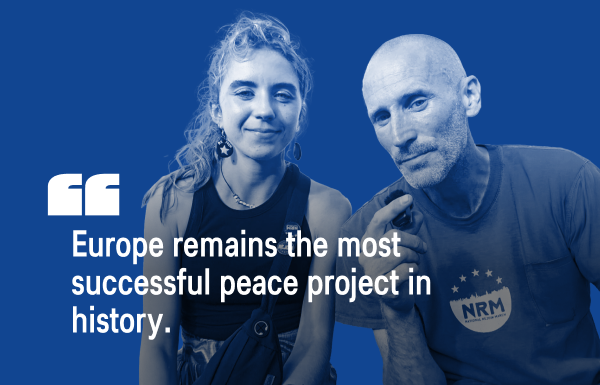
What we saw walking across the Ramble, specifically from Calais to Brussels, was that, everywhere you looked, there was memorials back to the wars. And what I brought home was the fact that what Europe came from was the idea that, if we bring countries together as one, work together politically, and tie together our economies, then we would not fight against each other anymore. And it has worked. So far, it is the most successful peace project there has ever been. And when I see people like Putin stoking the fire and using his extreme wealth to push Europe to split up in the way that it did with Brexit, I get deeply worried and take this matter seriously. This is why I strongly believe National Rejoin March is not just a jolly, not a get together, but it is a serious protest with some deep, relevant historical meaning behind it.
And we are not going to stop until we are back in the EU and we can work together again. What can turn it from street action to reality is initiatives like the Ramble, because it took real people’s voices directly to the European Parliament.
I am extremely happy that we successfully submitted the booklet to the EP thanks to the help of MEP Sandro Gozi. He even presented the book during parliamentary sessions between the UK and EU.
But what is most relevant to me is that, all of this, was done from grassroots. I’m just a lorry driver, just a normal guy. And Ceìra is just a normal girl who is just about to go and study nursing. And Claire is just a normal person, too. And Steve and Marissa, the five of us, are just normal people that do everyday normal jobs.
But we spoke directly to the heart of the EU Parliament. And I think we’ve proved we can now do that. So now we need to work on more ideas, to do the same, and keep on and on doing it..
Valentina:But, Peter, ave there been any concrete follow-ups after your visit to Brussels?
Peter: Yes, we had quite a lot of media attention from around the world, from Japan and America too, whilst very little in our own country, which does not surprise me, unfortunately.
Concerning the institutional follow-up, Sandro Gozi is bringing that book I was referring to – gathering nearly 150 people’s voices -, to every UK-EU meeting. Which is both endearing and sad, considering that one of the few people in the Parliament to have our back is not British. But that just goes to show how we are all the same, as Europeans, as human beings.
Valentina: Thank you, Peter. My next question is for James: Talk2EU is bringing the gap between the UK Citizens’ and the EU institutions through digital advocacy.
Can you tell us more about how your platform amplified voices that are often excluded from EU decision-making?
James: We started about a year ago, where we noticed there was a gap. In fact, if you look at the conversations around the UK and EU, they are very heated, probably because they are fuelled by a lot of our media here. I do not know if you’ve ever had the pleasure to read a British tabloid, but they are quite opinionated, if not openly aggressive in the way they report things.
So, we wanted to provide a place where people can go over the facts, what is really going on. We wanted to give a calm place to talk about Brexit, and get the message out of what the EU actually does, what place the UK did have in it, and what is really going on, what the EU is, what the relationship with the UK is, how can we improve the relationship, and what does that actually mean.
It is our attempt to make all of this more accessible and less politically charged in a way. And beyond petitions or social media campaigns, we are experimenting innovative digital tools and strategies to ensure these voices are not just heard, but also actively influence politics. So, we encourage people to reach out to local MPs, bring up the conversation, and push for real change.
However, the core of our work is ato keep the conversation going, and develop, closer ties to the EU though our outreach activities.
At the moment, our main initiative is pushing our petition to rejoin the EU. There have been plenty, and the last one got over 100,000, which will force the the UK Parliament to debate it. Therefore, we are contacting some influencers to help us push it and bring it to MPs and other decision makers. .
Valentina: Thank you so much, James.
“The National Rejoin March and Talk2EU remind us that Europe is not just a union of states—it’s a union of people. Whether through walking, marching, or clicking, citizens are finding creative ways to reclaim their place in European democracy. At Eumans, we’re committed to supporting these efforts, because we believe that a political Europe can only exist if it’s built by and for its citizens—no matter where they live or what passport they hold. Stay tuned for more ways to get involved!”
THE INTERVIEW WAS CONDUCTED BY FRANCESCO VECCHI AND VALENTINA DI VITO